Research
I study how supermassive black holes grow and how their activity relates to the evolution of their host galaxies. My work combines large spectroscopic surveys of hard X-ray selected AGN with spatially resolved integral-field spectroscopy of individual systems, and explores machine-learning methods for upcoming imaging surveys.
Hard X-ray selected AGN and their demographics
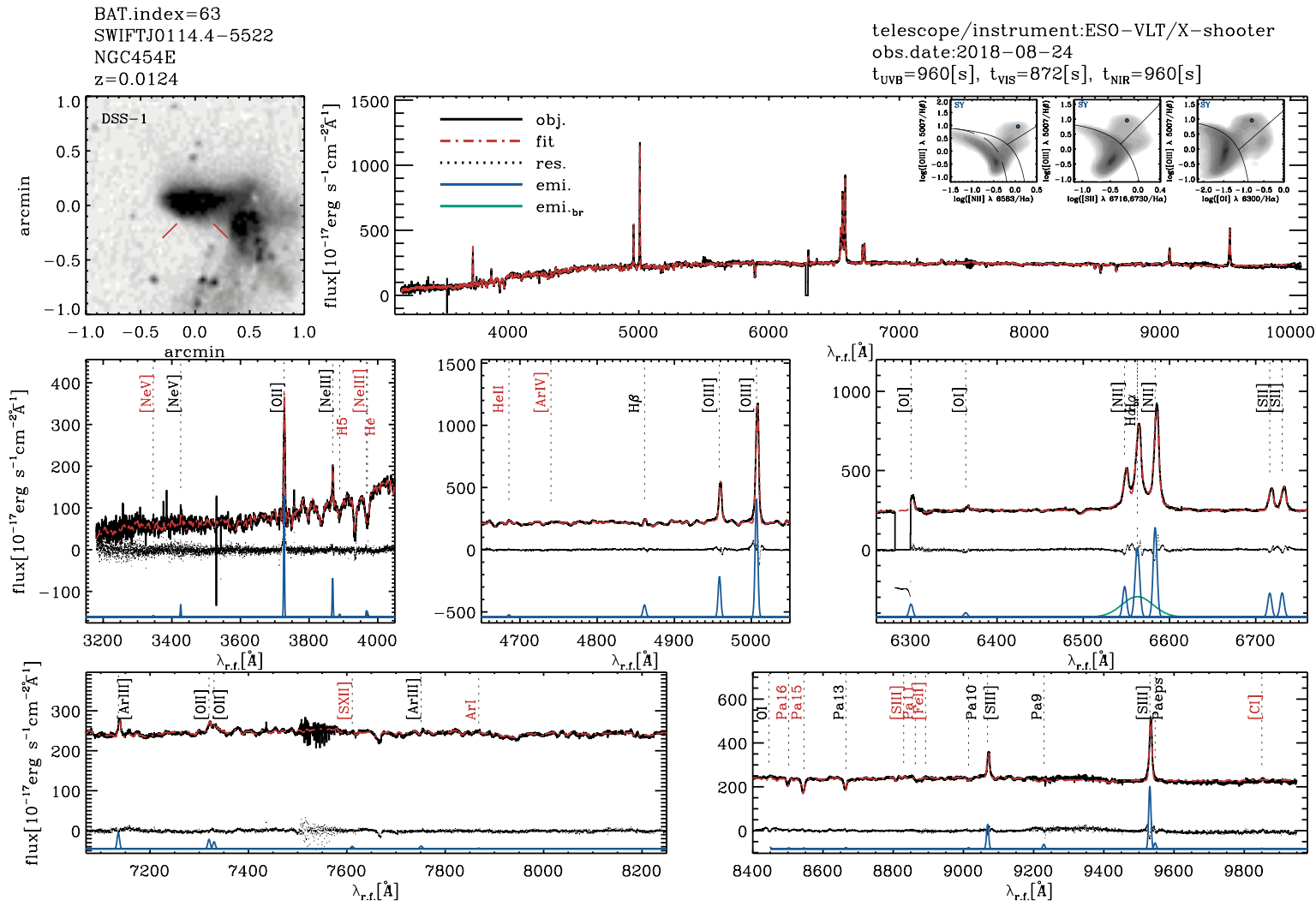
Hard X-ray selection above 10 keV provides a census of accretion that is relatively insensitive to obscuration. As a core member of the BAT AGN Spectroscopic Survey (BASS), I lead the optical spectroscopic analyses of nearby Swift-BAT AGN, including the emission-line measurements of the second data release. I am also the lead author of the Swift-BAT 105-month all-sky hard X-ray survey.
- BASS XXIV: The BASS DR2 Spectroscopic Line Measurements and AGN Demographics Oh et al. 2022, ApJS, 261, 4
- The Swift-BAT 105-month All-sky Hard X-ray Survey Oh et al. 2018, ApJS, 235, 4
Narrow emission lines as tracers of accretion state
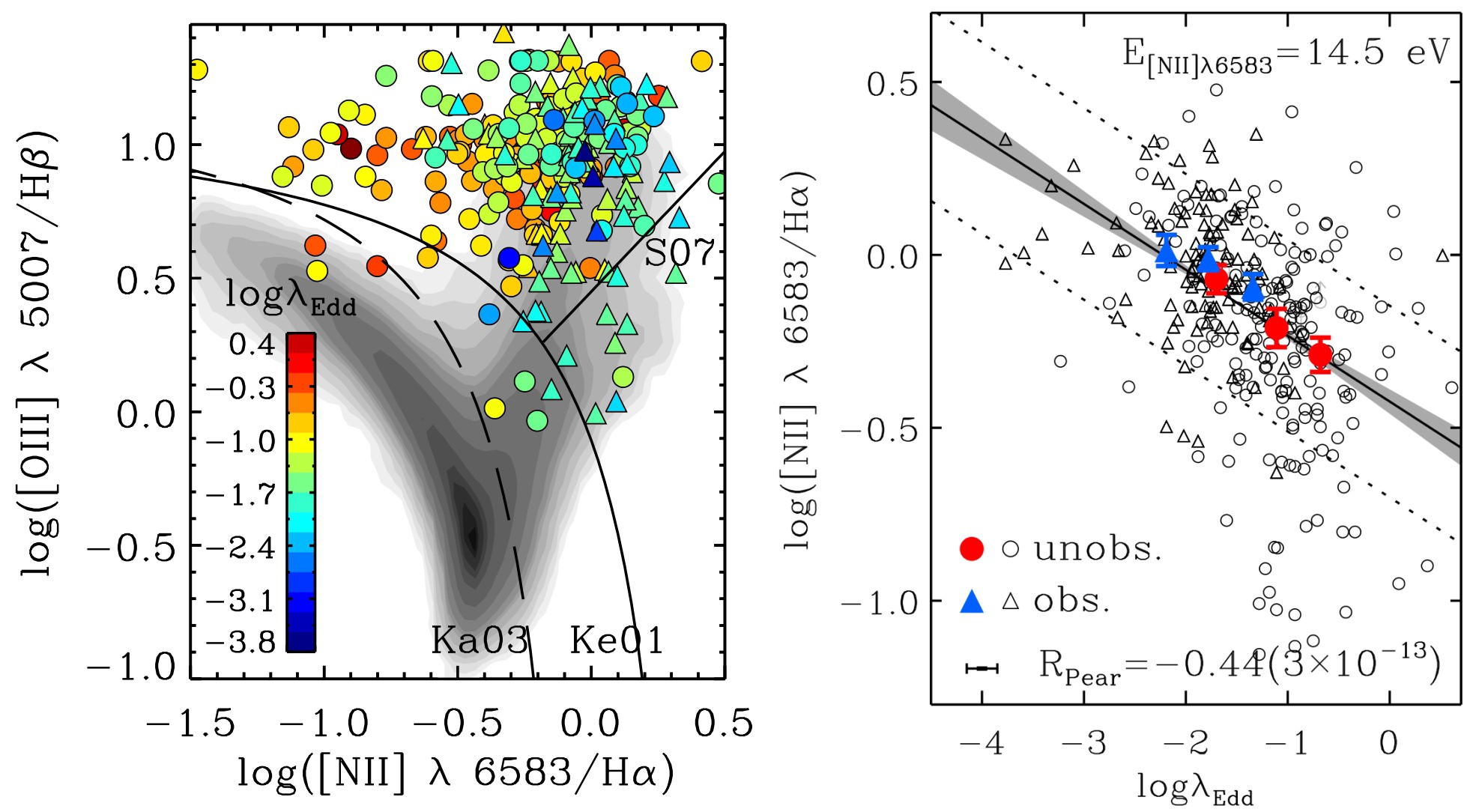
Narrow emission lines on galactic scales carry information about the central engine. Using BASS AGN, I showed that [N II]λ6583/Hα anti-correlates with the Eddington ratio. Near-infrared spectroscopy of X-ray selected broad-line AGN indicates that the relation persists to z ∼ 1.7.
- The Observed Relationship between MBH, Lbol, and λEdd with Optical Emission Line Ratios Oh et al. 2017
- An Observational Link between AGN Eddington Ratio and [N II]λ6583/Hα at 0.6 < z < 1.7 Oh et al. 2019, ApJ, 880, 112
Spatially resolved outflows and ionization
Integral-field spectroscopy resolves the kinematics and excitation of ionized gas on kiloparsec scales. With KOOLS-IFU on the 3.8 m Seimei Telescope and with the Hector Galaxy Survey, I study AGN-driven outflows, their energetics, and the ionizing sources behind extended LINER-like emission.
- Decoupled Kinematics and Excitation in the Compton-thick AGN NGC 6552: Spatially Resolved KOOLS-IFU Observations Oh et al. 2026b, ApJ, 1005, 185
- Hector Galaxy Survey: Optical IFU and Chandra Reveal a Low-Luminosity AGN Behind Extended LINER Emission Oh et al. 2026a, ApJ, 1005, 225
- AGN Outflows and their Properties in Mrk 766 Oh et al. 2025a, PASJ, 77, 562
![W80 and velocity asymmetry of [O III] as a function of log [O III]/Hβ](/publications/2026-oh-ngc6552/figure_hu_b1705f7a863feb88.png)
Machine learning for imaging surveys
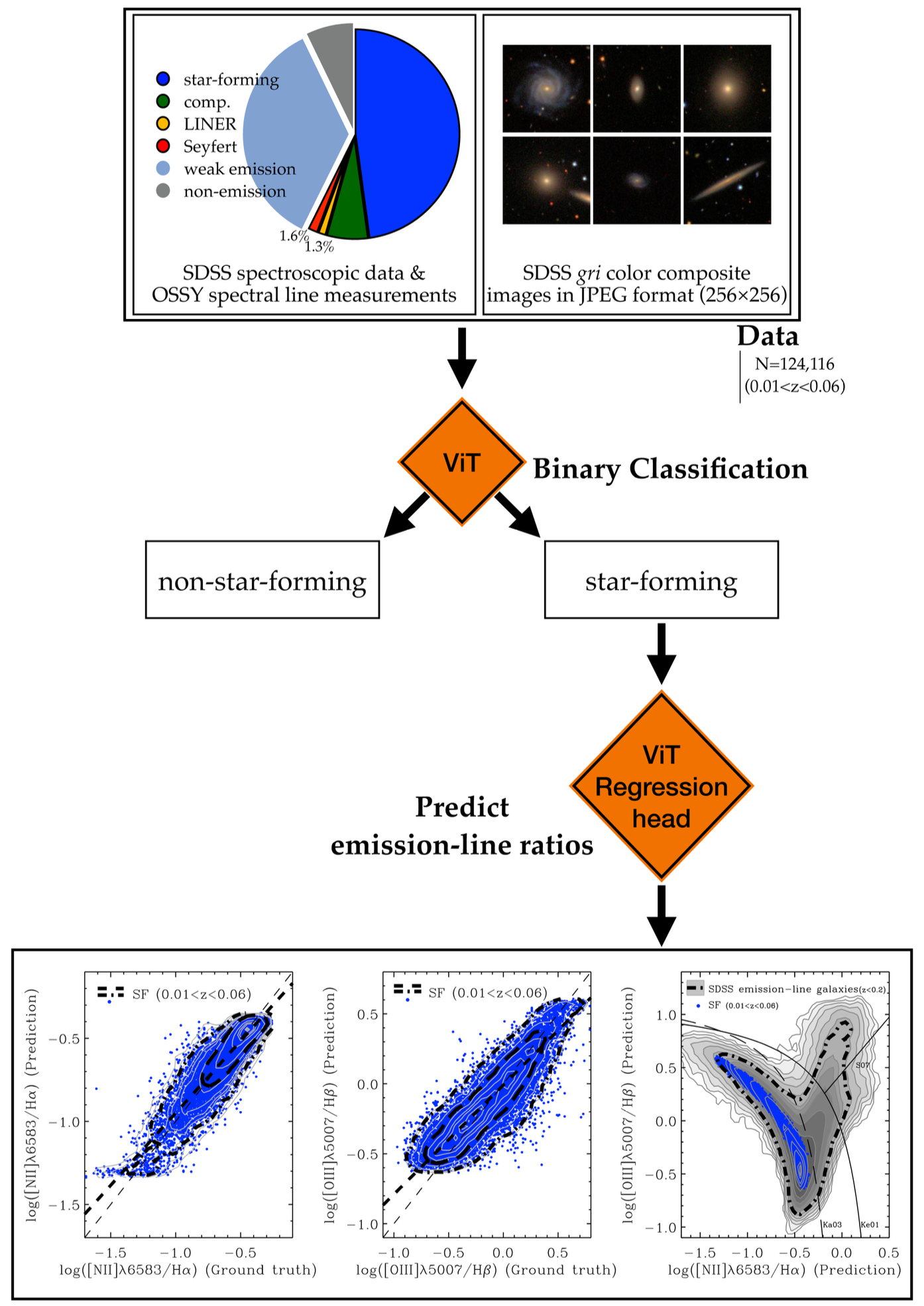
Upcoming imaging surveys will observe far more galaxies than can be followed up spectroscopically. I use Vision Transformers to infer star-formation activity directly from compressed galaxy images, with applications to Euclid, DES, and LSST.
- Capturing Star Formation Activity from Compressed Photometric Images of Galaxies Oh & Turp 2025b, ApJ, 991, 10
Spectral measurements of nearby galaxies
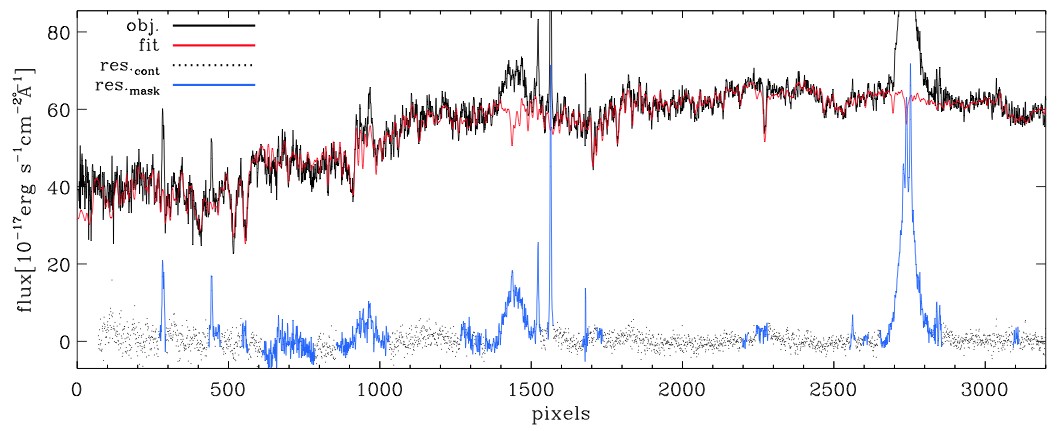
Separating nebular emission from stellar absorption underpins both AGN and star-formation diagnostics. I built the OSSY database of emission- and absorption-line measurements for more than 660,000 SDSS galaxies, and used it to study galaxy demographics along the Hubble sequence and to construct a catalog of type 1 AGN that includes objects with weak broad lines.
- Improved and Quality-assessed Emission and Absorption Line Measurements in SDSS Galaxies (the OSSY database) Oh et al. 2011, ApJS, 195, 13
- Demographics of Sloan Digital Sky Survey Galaxies along the Hubble Sequence Oh et al. 2013, AJ, 146, 151
- A New Catalog of Type 1 AGNs and its Implications on the AGN Unified Model Oh et al. 2015, ApJS, 219, 1
- Compact Elliptical Galaxies Hosting Active Galactic Nuclei in Isolated Environment Rey, Oh & Kim 2021, ApJL, 917, L9