Research

Publications

Selected refereed articles with short summaries. Complete and up-to-date lists are maintained on NASA ADS and ORCID.

2026

Oh et al. 2026bApJ, 1005, 185

Decoupled Kinematics and Excitation in the Compton-thick AGN NGC 6552: Spatially Resolved KOOLS-IFU Observations

KOOLS-IFU observations on the 3.8 m Seimei Telescope map the central ∼2 kpc of NGC 6552. The [O III]λ5007 width declines with radius, consistent with a decelerating central outflow, yet neither W80 nor Δv correlates significantly with [O III]/Hβ.

W80 and velocity asymmetry of [O III] as a function of log [O III]/Hβ
Oh et al. 2026aApJ, 1005, 225

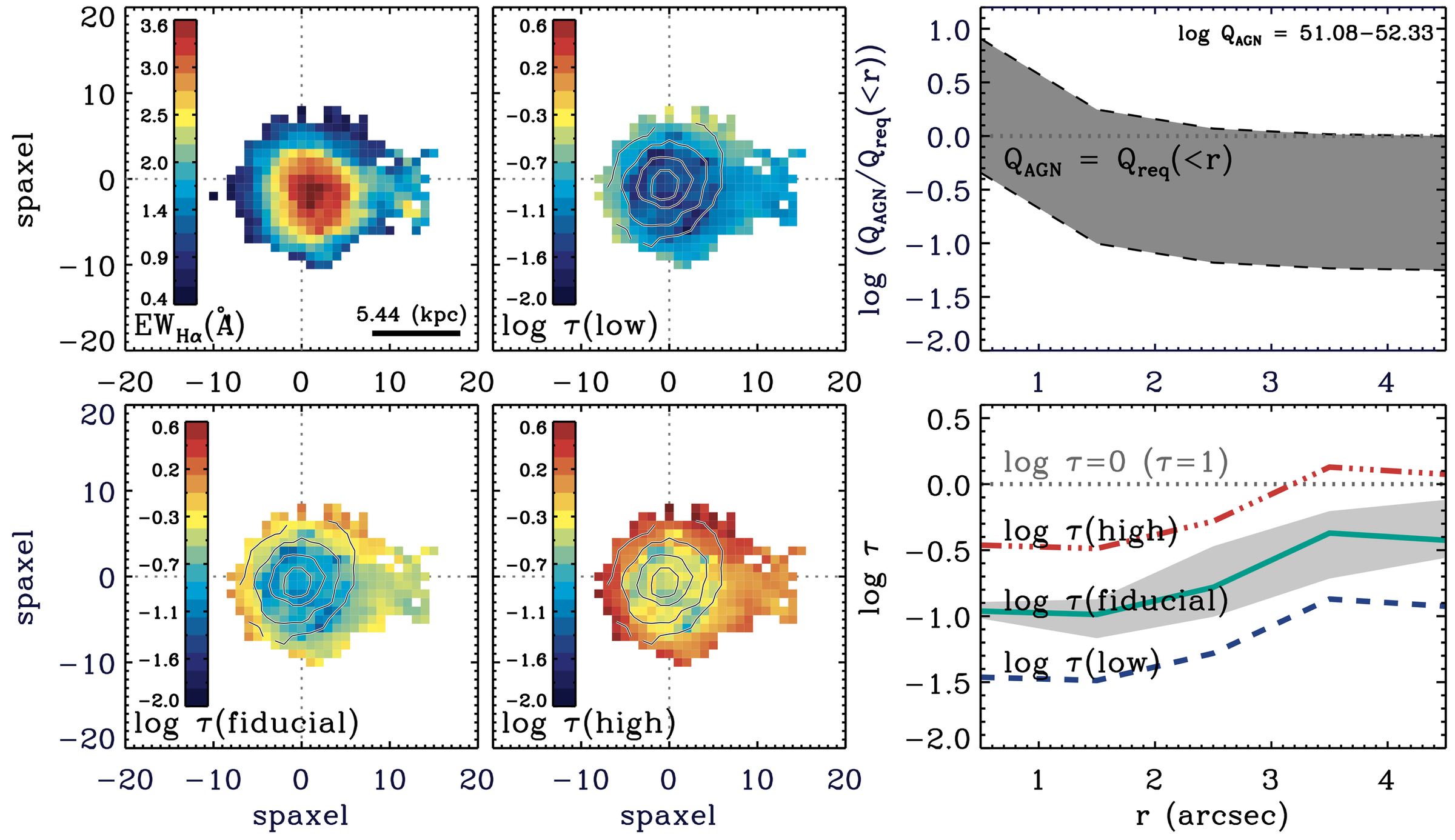
Hector Galaxy Survey: Optical IFU and Chandra Reveal a Low-Luminosity AGN Behind Extended LINER Emission

Hector IFS and archival Chandra data reveal a compact nuclear X-ray source in a galaxy with extended LINER-like emission. Spatially resolved photon-budget maps show that evolved stars alone cannot supply the required ionizing photons, which points to a weak LLAGN.

Spatially resolved EW(Hα) and ionizing-photon budget maps

2025

Oh & Turp 2025bApJ, 991, 10

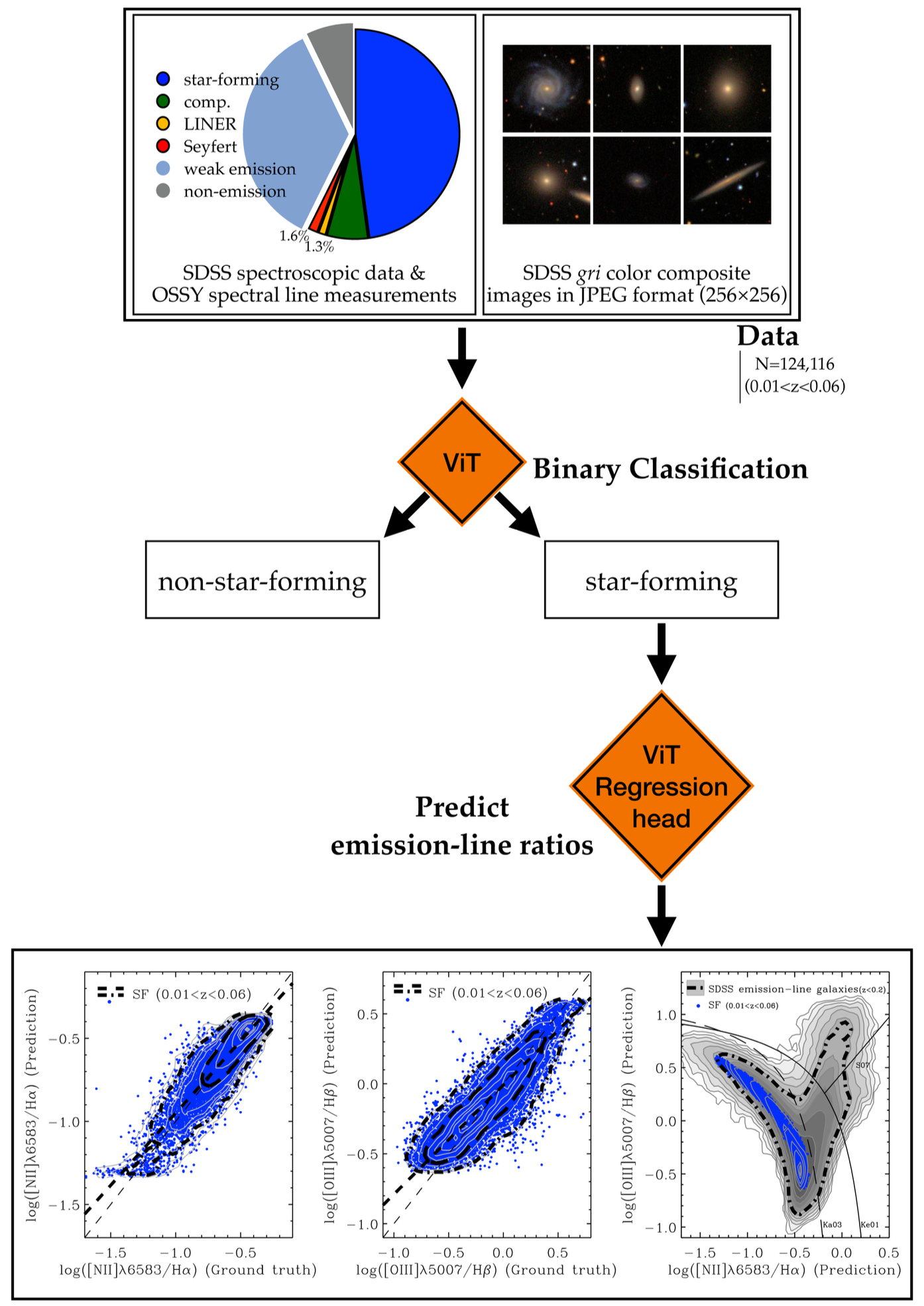
Capturing Star Formation Activity from Compressed Photometric Images of Galaxies

A Vision Transformer trained on ∼124,000 SDSS gri composite images identifies star-forming galaxies from JPEG images alone. The approach bypasses emission-line diagnostics and is aimed at Euclid, DES, and LSST.

Flowchart of the Vision Transformer approach
Oh et al. 2025aPASJ, 77, 562

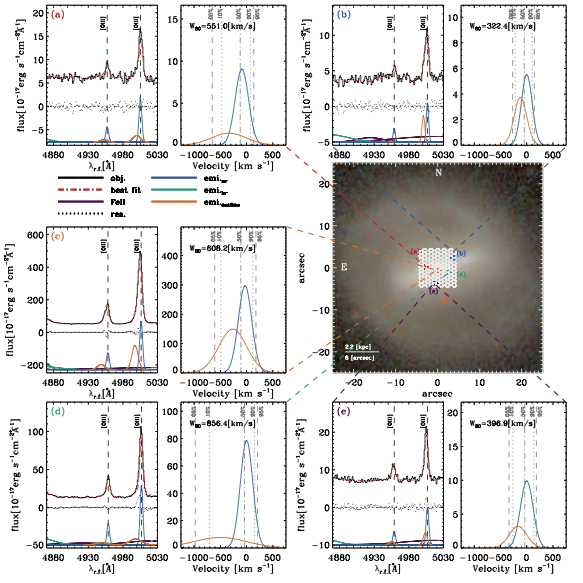
AGN Outflows and their Properties in Mrk 766

KOOLS-IFU data reveal asymmetric, radially distributed ionized outflows faster than 500 km s⁻¹ in the inner 2 kpc of Mrk 766. The kinetic power corresponds to 0.08% to 1.53% of the bolometric luminosity.

AGN-driven outflow components across the KOOLS-IFU field

2022

Oh et al. 2022ApJS, 261, 4

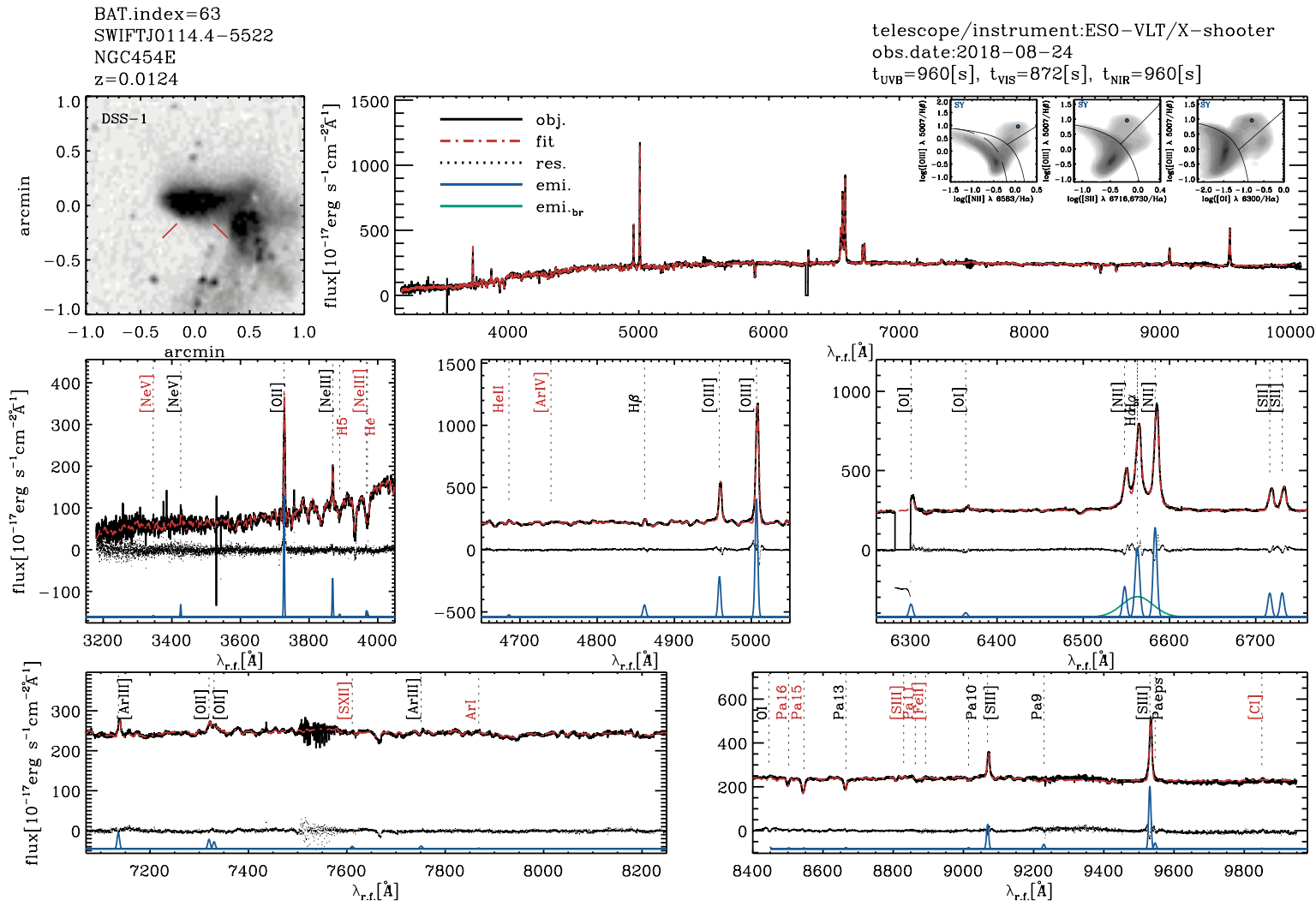
BASS XXIV: The BASS DR2 Spectroscopic Line Measurements and AGN Demographics

Optical emission-line measurements and AGN demographics for 743 of the 746 unbeamed AGN in the 70-month Swift-BAT catalog. Hard X-ray selection recovers a more heavily reddened population than optical selection in SDSS.

Example of spectral line fitting

2021

Rey, Oh & Kim 2021ApJL, 917, L9

Compact Elliptical Galaxies Hosting Active Galactic Nuclei in Isolated Environment

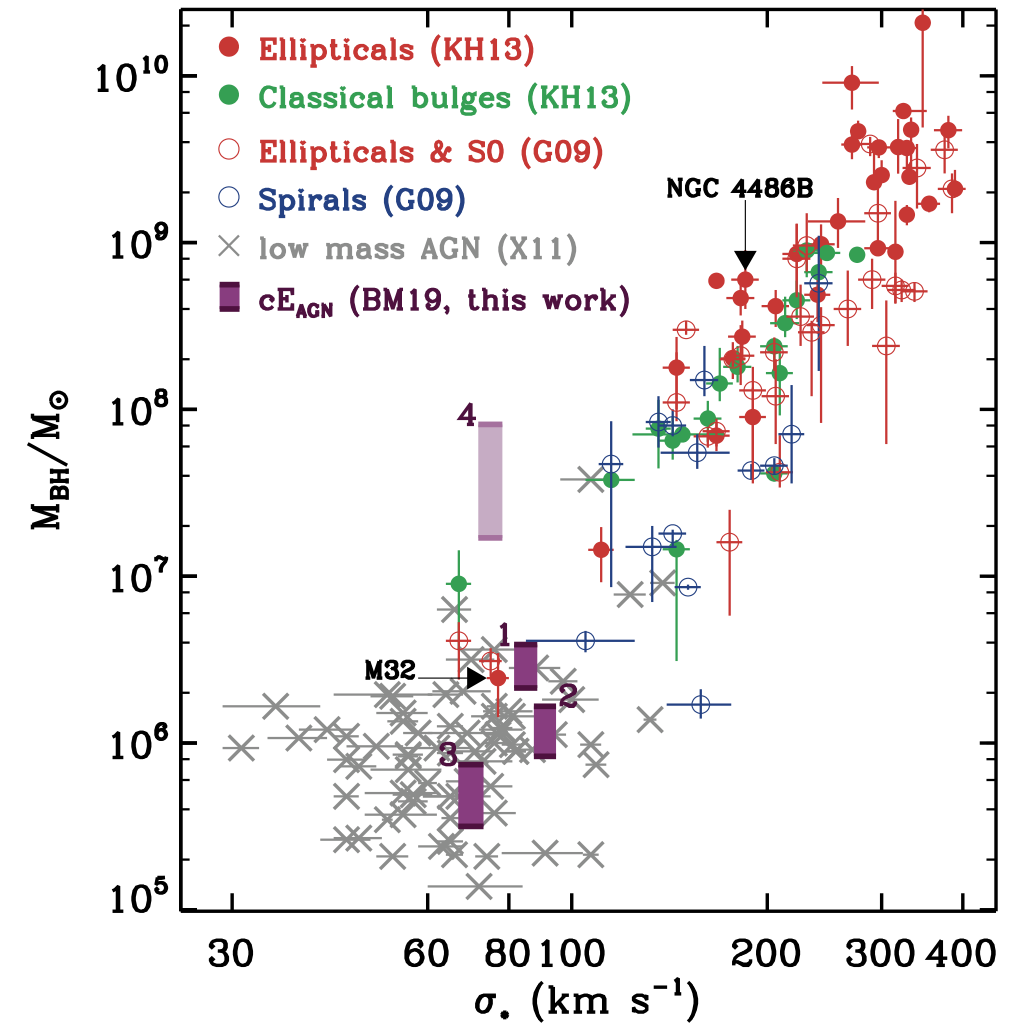
Four AGN are identified in isolated compact elliptical galaxies, with black hole masses of 7×10⁵ to 8×10⁷ M☉. The hosts follow the observed black hole scaling relations, which supports a nature origin for isolated cEs.

Black hole mass versus stellar velocity dispersion

2019

Oh et al. 2019ApJ, 880, 112

An Observational Link between AGN Eddington Ratio and [N II]λ6583/Hα at 0.6 < z < 1.7

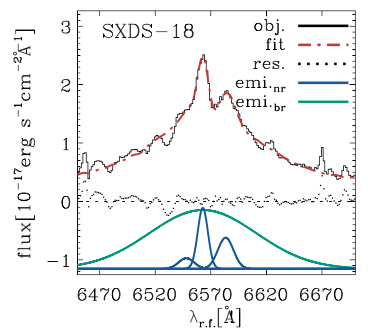
FMOS near-infrared spectra of X-ray-selected broad-line AGN at 0.6 < z < 1.7 show the same anti-correlation between Eddington ratio and [N II]λ6583/Hα that is found in local hard X-ray-selected AGN.

Broad and narrow emission-line decomposition

2018

Oh et al. 2018ApJS, 235, 4

The Swift-BAT 105-month All-sky Hard X-ray Survey

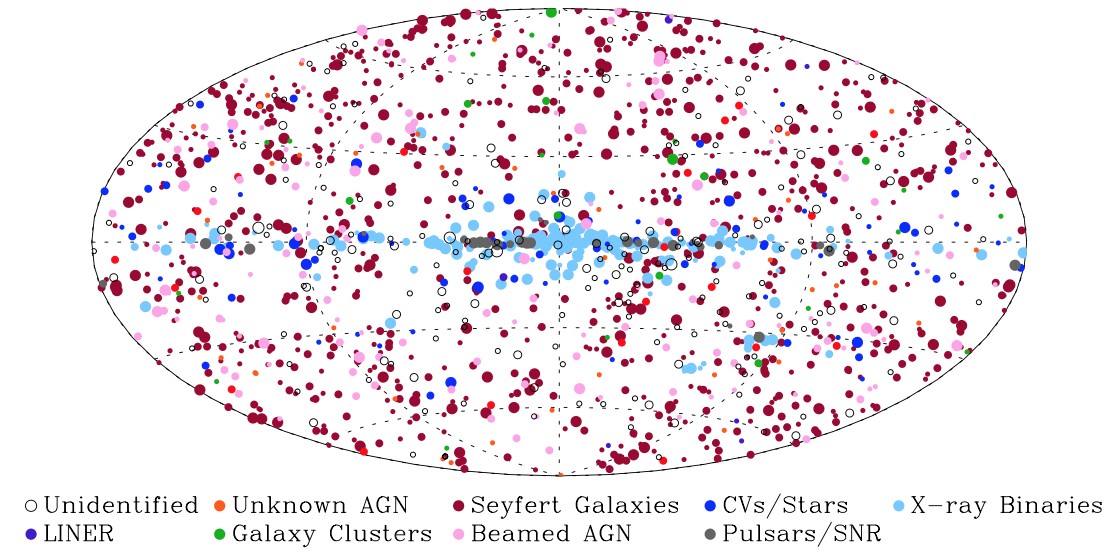
A uniform all-sky survey in the 14 to 195 keV band, including 423 new hard X-ray detections, released with eight-channel spectra and monthly sampled light curves for each source.

All-sky map of the Swift-BAT 105-month sources

2017

Oh et al. 2017

The Observed Relationship between MBH, Lbol, and λEdd with Optical Emission Line Ratios

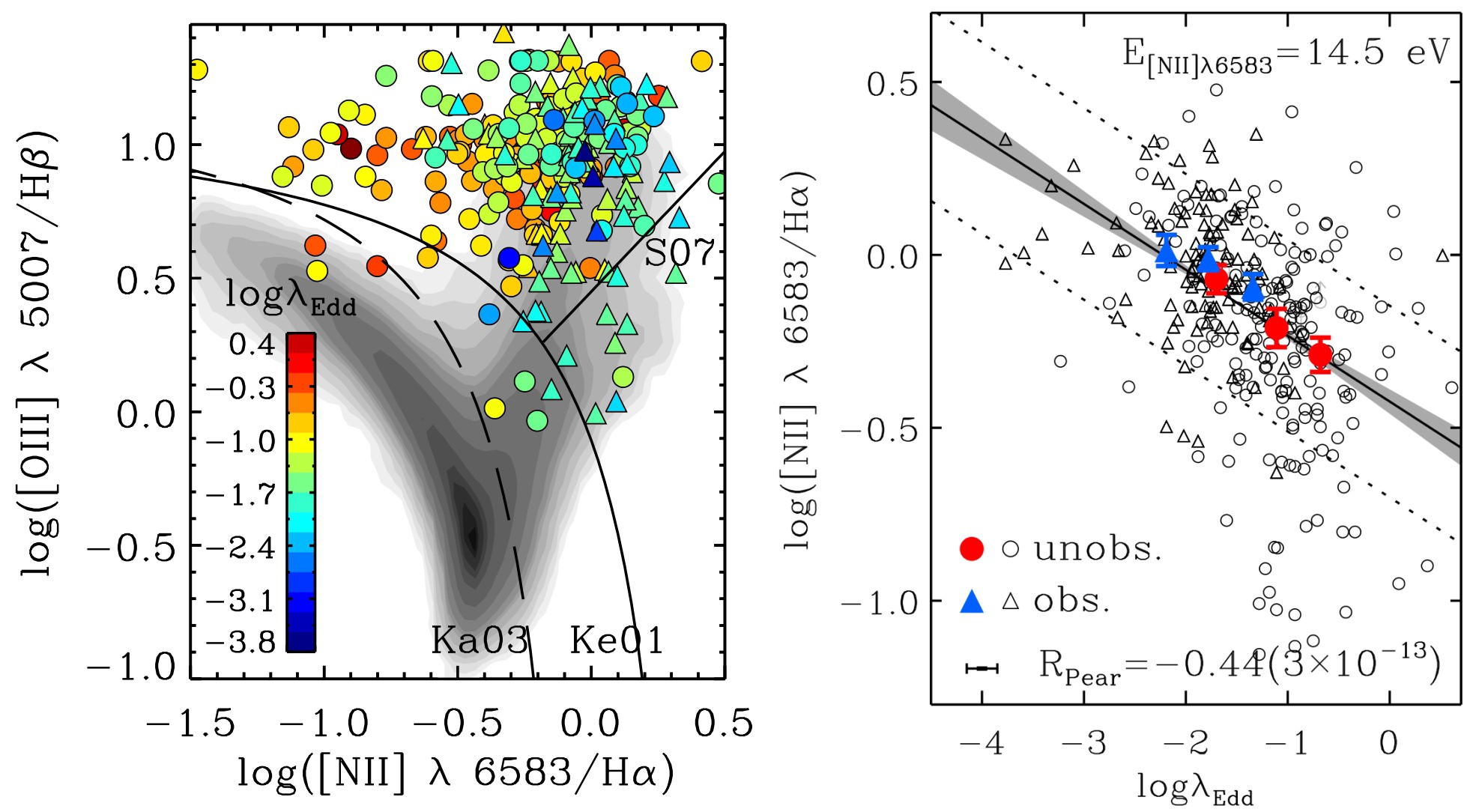
For nearby hard X-ray selected AGN from BASS, the [N II]λ6583/Hα ratio shows a significant anti-correlation with the Eddington ratio that is not driven solely by black hole mass or bolometric luminosity. The ratio is proposed as an indicator of the Eddington ratio with an rms scatter of about 0.6 dex.

BPT diagnostic diagram as a function of Eddington ratio for hard X-ray selected AGN (BASS)

2015

Oh et al. 2015ApJS, 219, 1

A New Catalog of Type 1 AGNs and its Implications on the AGN Unified Model

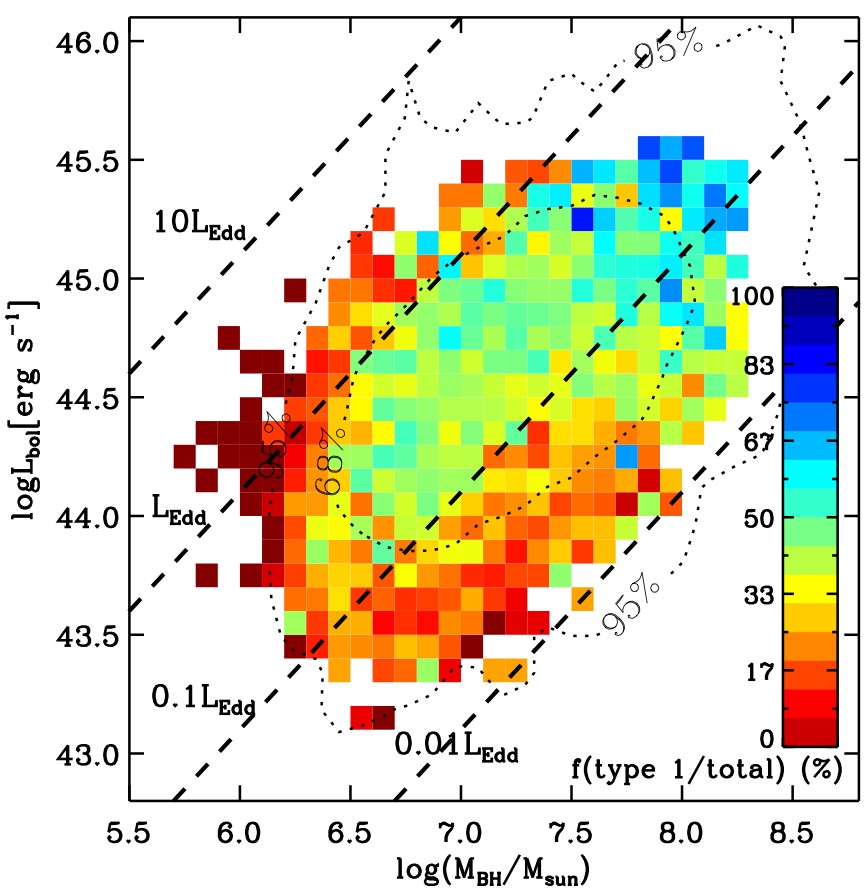
A new catalog of type 1 AGN at z < 0.2 reveals a large population of galaxies with weak broad-line regions. The type 1 fraction, a measure of the average torus opening angle, is not set by black hole mass or bolometric luminosity alone, which indicates that the receding torus model is only partially valid.

Black hole mass and bolometric luminosity of type 1 AGN, colored by type 1 AGN fraction

2013

Oh et al. 2013AJ, 146, 151

Demographics of Sloan Digital Sky Survey Galaxies along the Hubble Sequence

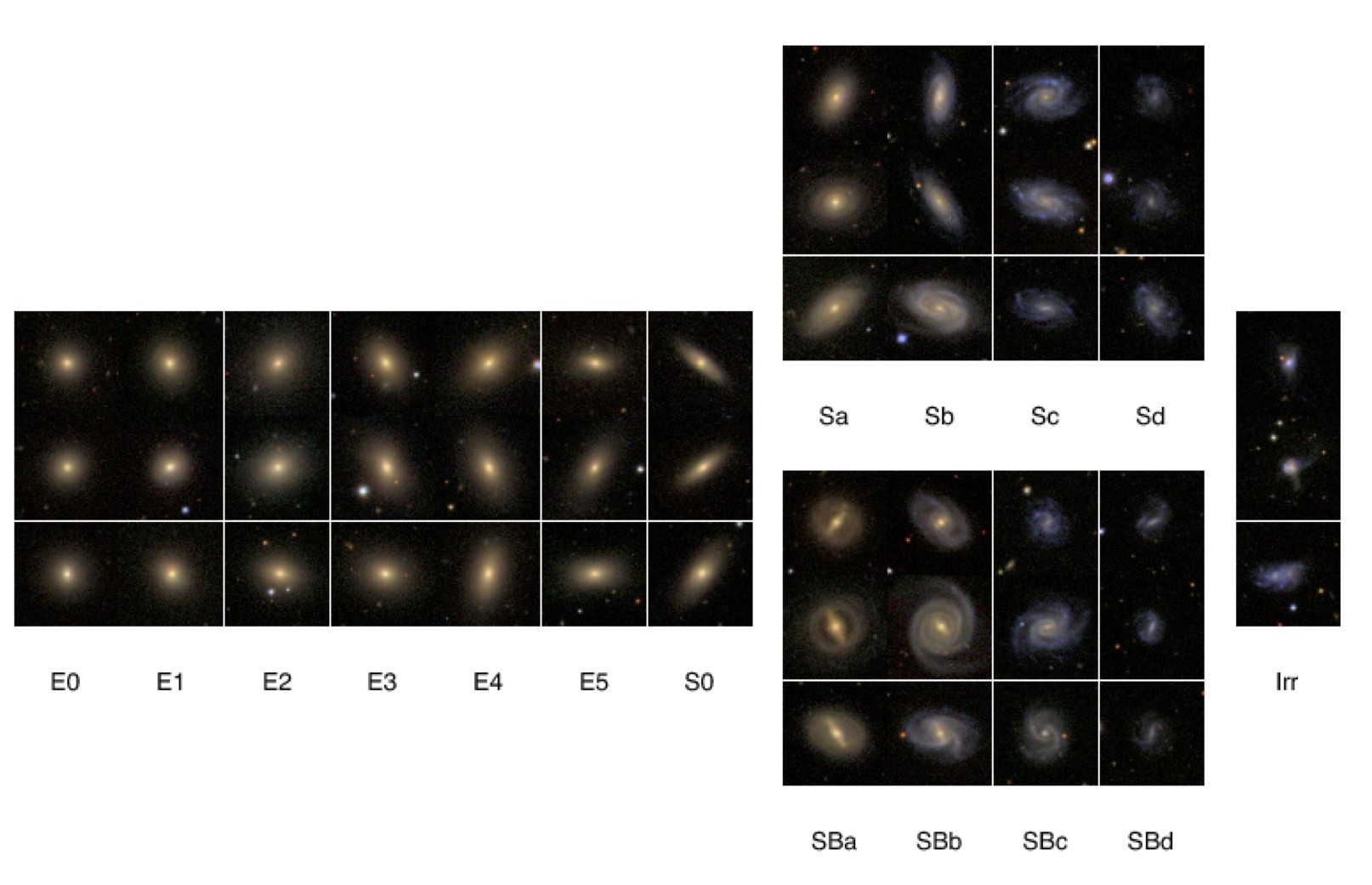
Statistical properties of a volume-limited sample of 7429 nearby galaxies at 0.033 < z < 0.044 from SDSS DR7. Visual morphologies are combined with structural and spectroscopic properties from the OSSY catalog, which confirms the known correlations between morphology, line strengths, and stellar ages.

SDSS DR7 composite images of galaxies classified along the Hubble sequence

2011

Oh et al. 2011ApJS, 195, 13

Improved and Quality-assessed Emission and Absorption Line Measurements in SDSS Galaxies (the OSSY database)

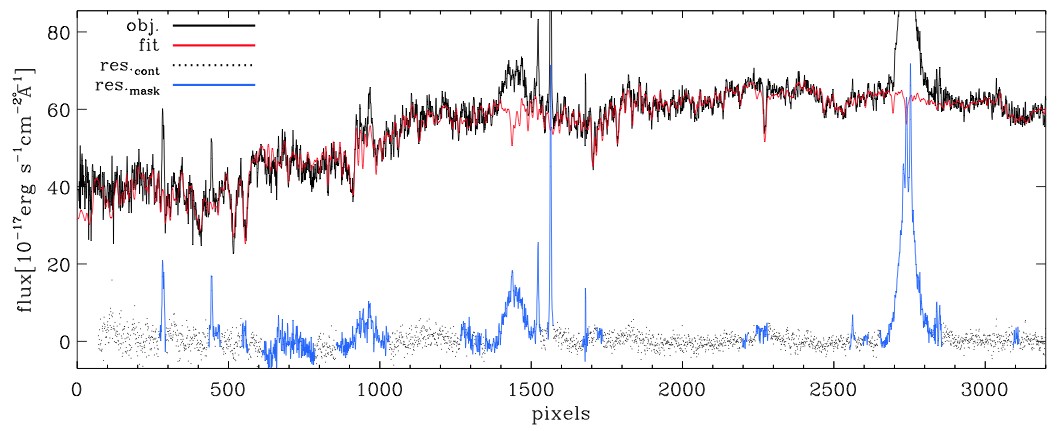
Emission- and absorption-line measurements for 664,187 SDSS galaxies at z < 0.2, obtained by separating nebular emission from stellar absorption with empirical stellar templates. The public OSSY database also provides a quality parameter that assesses each spectral fit.

Example of spectral line decomposition

Talks, awards, grants, and accepted telescope proposals are listed in the CV.

Download CV (PDF)
Click to close